
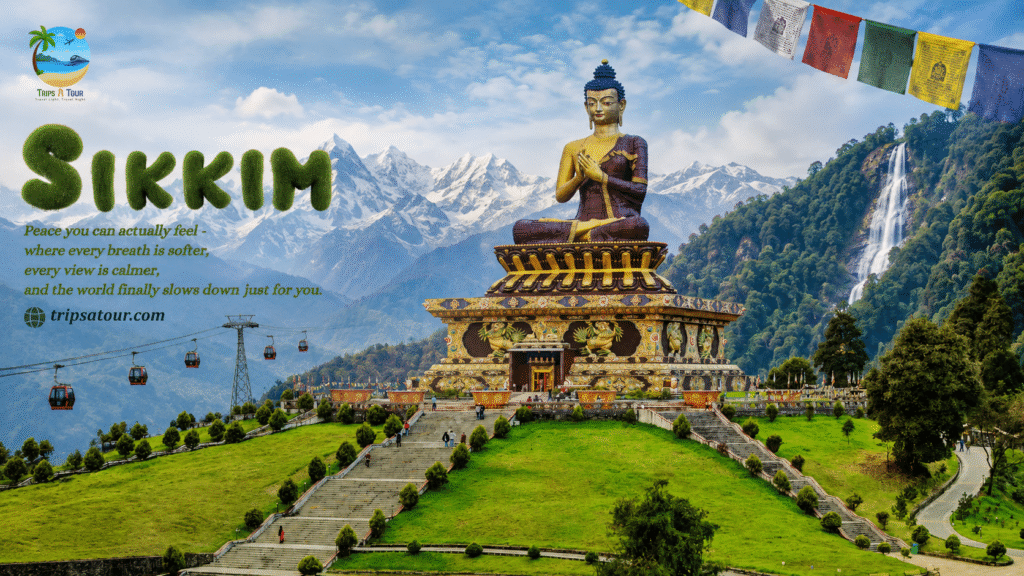
In the Eastern Himalayas, Sikkim is surrounded by Tibet (China) to the north, Nepal to the west, and Bhutan to the east. It actually feels like “a remote Himalayan kingdom”.
Its green valleys are “wrapped in rhododendron forests”. There are “orchid carpets flung far and wide”.
All this lies below the soaring spires of Kangchenjunga (8,586m). It is the world’s third-highest mountain.
This small state covers an unprecedented elevation range. It goes from 310m to 8,586m. It sweeps from verdant foothills to permanent snows.
Khangchendzonga National Park safeguards more than 25% of Sikkim’s total land area, serving as a vital sanctuary for its natural heritage.
It is regarded as one of the most significant ecological hotspots in India. Glacial lakes and concealed alpine meadows interrupt woodlands.
Nature, Culture, and Sacred Heights of Sikkim
Under towering peaks, vibrant forests thrive alongside crystal-clear, sparkling lakes. Tsomgo Lake (3,753m) freezes in winter, shifting hues with the seasons, while the sacred Gurudongmar Lake (5,425m), one of the world’s highest, is revered by Buddhists and Hindus. Remarkably, wildlife also inhabits these high altitudes.
Sikkim is a remarkable biodiversity hotspot, home to almost half of India’s bird species, as well as colorful orchids and rhododendrons. The dense woodlands serve as a hidden sanctuary for rare wildlife, including the shy snow leopard and the charming red panda. In every sense, Sikkim is a vibrant natural paradise where the magic of wildlife and flora comes alive.
Sikkim’s heart is in its varied people—Lepchas, Bhutias, and Nepalis—who harmoniously coexist. Sikkim lives up to its motto, “The land of all.” The state shines with vibrant unity, festive energy, and hills dotted with sacred temples.
So, eager to touch the clouds in Sikkim? Fantastic! But let’s get down to business first—how do you get there, actually? Well, Sikkim, a long-time Himalayan secret, is now accessible and open to welcome all travelers!
How to Get to Sikkim – Pick Your Entry Gate, Traveller!
Let’s discuss all the possible ways to Sikkim—by air, train, road, or even those good ol’ public buses!
By Air – Flying High into the Hills
Pakyong Airport (PYG) — Sikkim’s very own gateway.
- Sikkim’s sole airport lies approximately 35 kilometres away from the heart of Gangtok.
- Flights are mostly limited to Delhi, Kolkata, and Guwahati due to weather and technical issues.
- Airlines: SpiceJet was the largest operator, but operations are seasonal or shut temporarily—always pre-book in advance!
Tip: Since Pakyong is the nearest, flights here may be unpredictable during the monsoons or winter due to reduced visibility.
Bagdogra Airport (IXB), West Bengal – The Key Gateway
- Located just 125 km from Gangtok, this is the most reliable and well-linked airport near Sikkim.
- Flight Connections: Frequent daily flights from Delhi, Mumbai, Kolkata, Bangalore, Chennai, and Guwahati.
- Travel from Bagdogra to Gangtok takes around 4.5 hours via private cab, shared taxi, or SNT bus.
- Bonus? From Bagdogra to Gangtok, misty hills, tea gardens, and the winding Teesta river create a magical view.
By Train – Ride the Rails to the Foothills
Sikkim doesn’t have its own railway station yet—the nearest one is New Jalpaiguri (NJP) in Siliguri, West Bengal.
New Jalpaiguri (NJP) – The Nearest Railhead
- Gangtok to destination: Approx. 120 km, 4–5 hours by road.
- Good connectivity with major cities, including Delhi, Kolkata, Mumbai, Chennai, Bengaluru, and Guwahati.
- Popular trains:
- Darjeeling Mail (from Sealdah)
- Padatik Express
- North East Express
- Kamrup Express
From NJP to Sikkim:
- Take a shared taxi, private cab, or bus from Siliguri SNT Terminal.
- Cost: ₹300–₹500 per person (shared), ₹3000–₹3500 for private taxis.
By Road – The Scenic Himalayan Drive
Sikkim’s twisting mountain roads offer breathtaking scenery and real adventure—the adventure begins here by bus, jeep, or car!
Private Taxi / Self-Drive:
- Hire a cab from Siliguri or Bagdogra to reach Gangtok, Pelling, Namchi, or Ravangla.
- NH10 is the main highway linking Sikkim with West Bengal.
Tip: In case of self-driving, prepare for hilly routes and potential monsoon landslides!
Shared Cabs / Sumos
- Operated from Siliguri (near Tenzing Norgay Bus Stand), NJP, or Bagdogra.
- Cheapest and most widely available local transport mode.
- Runs every 30 to 45 minutes throughout the day.
- Fare to Gangtok is ₹300–₹500 per person, depending on vehicle and demand..
Buses:
- Run by Sikkim Nationalized Transport (SNT from:
- Siliguri SNT Bus Stand to Gangtok, Namchi, Mangan, etc.
- Limited luxury and AC buses—basic yet budget-friendly!
- Fare: ₹150–₹300
- Timings: Primarily early morning to afternoon.
Pro Tips – Choosing the Right Entry for You:
Traveller Type Best Route Why?
- Budget Backpacker Train to NJP + Shared Cab to Gangtok, Affordable, scenic
- Luxury Tourist Flight to Bagdogra + Private Cab, Comfortable & quick
- Adventurous Roadie Self-drive via NH10 from Siliguri Epic road trip vibes
- Flying Fast Packer Flight to Pakyong (if available), Direct entry to Gangtok
- Group Travelers SNT Bus or Private Taxi (split cost), Cost-effective for groups
Where to Stay – Luxury, Mid-Budget, Backpacker… Sikkim Has It All!
Luxury Escapes –
Find Sikkim in luxury with these top picks of high-end stays.
- Mayfair Spa Resort & Casino, Gangtok: Located on 48 acres of pine forest, this 5-star resort has India’s first live casino. The property boasts a luxurious spa, a refreshing outdoor pool, a well-equipped fitness center, and a variety of dining venues to satisfy every palate. Balconies in rooms provide valley views, 24/7 in-room dining, and complimentary minibars. OJust a short 10-kilometer drive from Gangtok and only 35 minutes away from Pakyong Airport. Price: ₹22,000–25,000/night (all meals). Customers like the atmosphere and staff. Book directly on the Mayfair website or via major travel portals.
- The Elgin Nor Khill, Gangtok: A heritage 5-star hotel in the heart of Gangtok since 1932, with spa, lounge bar, and garden-view balcony rooms. Close to MG Marg. Tariffs: ₹16,000–22,000. Famous for refined décor and friendly service.
- Jewel Kongchen Retreat, Lachung: An upscale hotel in North Sikkim with central heating, spa, fine dining, and splendid valley views. Wi-Fi and mini-bars are available in modern rooms. Rates from ₹8,000+. Perfect after trekking.
- Elgin Mount Pandim, Pelling: A peaceful heritage retreat with Kanchenjunga views, constructed by Sikkim royalty. Features spa, bar, and mountain-view rooms. Charges: ₹12,000–18,000. Close to Pemyangtse Monastery. Book on respective hotel websites, Booking.com, or Agoda.
Mid-Budget & Budget Stays in Sikkim:
Sikkim boasts mid-budget and budget stays with breathtaking Himalayan scenery, warm local atmosphere, and excellent comfort, all at reasonable prices.
Mid-Budget Stays:
You don’t have to break the bank for Kanchenjunga vistas. There are several 3-4 star hotels in Gangtok, Pelling, and North Sikkim with comfortable rooms that have modern facilities. They also have breakfast at affordable prices.
- Summit Golden Crescent (Gangtok): A 3-star resort ~1 km from MG Marg with rooftop viewing area, spa, cafe, and garden views. Rooms (₹4,000–6,000) with Wi-Fi, TV, 24-hr service, and breakfast.
- Pine Crest Hotel Udaan in Pelling: A 4-star vegetarian retreat nestled within serene pine forests. Hopes for balconies overlooking Kanchenjunga, a spa, and an in-house restaurant (~₹5,000–7,000).
- Dikey Khangsar Residency (Lachen): Dikey Khangsar Residency in Lachen is a budget-friendly guesthouse offering cosy private rooms, hot water, home-cooked meals, and welcoming hosts. Price: ₹1,500–3,000. Ideal for Gurudongmar visitors.
Most mid-range accommodations are available on Booking.com, Agoda, or hotel websites and include breakfast.
Backpacker & Budget Stays:
For shoestring backpackers, Sikkim has a good number of hostels, homestays, and no-frills guesthouses with a social atmosphere and local flavour.
- Zostel Gangtok: Dorms/private rooms with Wi-Fi, terrace lounge, café, and social activities. Beds starting at ₹700.
- HoHouse of Nomad in Gangtok is a cozy hostel featuring dorms, a garden, and café, all for under ₹800, with a friendly vibe and a 9.1 rating.
- Zostel Rinchenpong: Rural lodge close to Pelling with a garden, a common lounge, and picturesque views.
- B11 Hostel (Lachen): Budget-friendly stay with shared bathrooms, breakfast included, and scenic mountain views (~₹400).
Try homestays such as Namgyal (Yuksom) or Jiva (Pelling) for basic rooms (~₹1,000–2,000), local food, and immersion.
What to Eat in Sikkim:
Sikkim’s culinary landscape is a spice-kissed, steam-perfumed love letter. Every mouthful is a tale of the mountains, the monasteries, and the multicultural heritage of this Himalayan paradise.
Sikkimese food has Nepali, Tibetan, and Lepcha notes. It is robust soups, dumplings, and earthy fermented fare that warm and sustain:
Here’s what your taste buds shouldn’t miss before you depart Sikkim:
- Momo (The Eternal King): Chicken, pork, cheese, or veggie — smothered in hot chilli chutney. Roadside stalls around MG Marg or secret joints in Namchi sell the most succulent ones.
- Thukpa: Noodle soup, Tibetan-style. Spicy and soul-warming — perfect for cold winter nights.
- Phagshapa: Pork belly with radish, dried chillies, and no guilt. A must for all pork aficionados.
- Sha Phaley: Fried dumplings filled with meat and affection. Crunchy shell, bursting with juicy goodness inside — need we say more?
- Chhang: Malted millet beer, fermented and warm, served in bamboo mugs. Punchy and vibe-y!
Pro Tip:
Ditch high-end restaurants for one day and go for local huts, preferably close to monasteries or village trekking routes.
That’s where the magic bubbles.
Where to Eat by Region:
Gangtok:
| Name (Location) | Type | Hours | Signature Dish |
|---|---|---|---|
| Taste of Tibet (MG Marg) | Tibetan/Chinese | 11:30–21:00 daily | Thukpa, Momos |
| Shuffle Momos (MG Marg) | Momo Café | 11:00–21:00 daily | 16+ Momo Varieties |
| The Roll House (MG Marg) | Snack Deli | 08:00–22:00 daily | Momos, Sha Phaley |
| Golden Dragon Hotel (MG Marg) | Chinese/Nepali | 11:00–22:00 daily | Phagshapa (pork-radish stew) |
| Hill Queen (MG Marg) | Nepali/Thakali | 10:00–22:00 daily | Gundruk, Sinki, Masauyra |
| 9ine Native Cuisine (MG Marg) | Nepali Thakali | 11:00–22:00 daily | Kinema with Rice |
| Kookay Restaurant (MG Marg) | Nepali | 10:00–21:00 daily | Kinema Curry, Thali Sets |
| Bhansa Ghar (MG Marg) | Nepali Homestyle | 11:00–15:00 daily | Dal-Bhat with Curries |
| Osm Restaurant (MG Marg) | Nepali/Continental | 11:00–22:00 daily | Dal-Bhat, Fusion Dishes |
| Parivar Pure Veg (MG Marg) | Vegetarian Café | 10:00–20:00 daily | Sel Roti, Nepali Snacks |
| Agarwal Pure Veg (MG Marg) | Vegetarian Café | 10:00–21:00 daily | Sel Roti, Parathas |
Many street corners and dhabas on MG Marg, Gangtok, sell snacks like chilli achar, aloo dum, and tea. The best time for fresh momos or thukpa is morning or after 5 pm, when tourists and locals frequent these eateries.
Pelling:
| Name (Location) | Type | Hours | Signature Dish |
|---|---|---|---|
| Rabdentse Residency Restaurant (Pelling Town) | Mountain café | 08:00–22:00 (daily) | Tibetan/Nepali buffet: momos, thukpa |
| Melting Point Restaurant (Pelling) | Multi-cuisine | 10:00–22:00 (daily) | Sikkimese/Nepali dishes (thupka, aloo curries) |
| Evergreen Restaurant (Pelling) | Nepali/Indian | 08:00–22:00 (daily) | Thakali thalis, momo, noodle soups |
| Lotus Bakery & Cafe (Pelling) | Bakery/Cafe | 07:00–19:00 (daily) | Fresh bread, cakes, cookies; light snacks |
| Hotel Kabur Restaurant (Pelling) | Nepali homestyle | 07:00–22:00 (daily) | Hearty Nepali curries, millet rotis |
Budget Breakdown – Let’s Count the Bucks!
Here’s a concise budget guide for a 6-day, 5-night Sikkim trip covering Gangtok and Pelling, with options for different travel styles:
| Category | Shoestring (INR) | Mid-Range (INR) | Luxury (INR) |
|---|---|---|---|
| Stay (per night) | ₹600 – ₹1,200 | ₹1,500 – ₹3,500 | ₹6,000 – ₹15,000 |
| Total Stay (5 nights) | ₹3,000 – ₹6,000 | ₹7,500 – ₹17,500 | ₹30,000 – ₹75,000 |
| Meals (per day) | ₹250 – ₹400 | ₹500 – ₹1,000 | ₹1,500 – ₹3,000 |
| Total Meals | ₹1,500 – ₹2,500 | ₹3,000 – ₹6,000 | ₹9,000 – ₹18,000 |
| Transport (in-state) | ₹1,000 – ₹2,000 | ₹3,000 – ₹5,000 | ₹6,000 – ₹12,000 |
| Sightseeing & Permits | ₹1,000 – ₹1,500 | ₹2,000 – ₹3,500 | ₹4,000 – ₹7,000 |
| Shopping & Souvenirs | ₹500 – ₹1,000 | ₹1,500 – ₹3,000 | ₹5,000+ |
| Miscellaneous | ₹500 – ₹1,000 | ₹1,000 – ₹2,000 | ₹2,500+ |
| Flight/Train to NJP/Bagdogra (round trip) | ₹2,500 – ₹7,000 | ₹5,000 – ₹9,000 | ₹8,000 – ₹15,000 |
| Total Estimated Budget | ₹10,000 – ₹21,000 | ₹23,000 – ₹46,000 | ₹65,000 – ₹1,30,000+ |
10-Day Sikkim Exploration Plan – Full Circuit:
Sikkim is a beautiful Himalayan state known for its diverse landscapes, vibrant culture, and spiritual charm. To experience Sikkim to the fullest, schedule a 10–12-day journey over its best highlights. Cover everything from lively Gangtok to serene North Sikkim.
Day 1:
Travel Duration: Approximately 5 hours by road.
- Reach NJP Railway Station or Bagdogra Airport. From there, take a scenic drive to the capital city of Sikkim, Gangtok.
- Visit your hotel and relax to acclimatize to the climate and altitude.
- Evening: take a leisurely walk along MG Marg, the social hub of Gangtok with cafes, shops, and street performers. It’s ideal for your first sampling of local food and culture.
- Night stay in Gangtok.
Day 2:
Explore Gangtok’s rich spiritual and cultural heritage:
- Rumtek Monastery is an important Tibetan Buddhist monastery with stunning architecture and serene surrounding environment. Visit here.
- Proceed to Tashi View Point for a sweeping panorama of the Kanchenjunga range of mountains — the world’s third-highest peak.
- Pause at Hanuman Tok, a tranquil hilltop temple overlooking the peaceful valley below.
- See the historic Enchey Monastery, which is a 19th-century old one.
- Explore Tibetan heritage and Buddhist art at the Namgyal Institute of Tibetan Studies.
- Gangtok Ropeway — a spine-tingling cable car ride with breathtaking city and hill views.
- Overnight stay at Gangtok.
Day 3:
Important: ILP is mandatory and usually arranged by your hotel or tour operator.
- A dawn adventure awaits at Tsomgo Lake—perched 12,400 feet high, this icy jewel sits surrounded by towering snow-clad mountains. Take yak rides and local refreshments here.
- Visit the shrine of Baba Harbhajan Singh. It honours a brave Indian soldier.
- Proceed to Nathula Pass (14,140 ft), an old Indo-China border crossing open Wednesday to Sunday.
- Back in Gangtok in the evening.
Note: Nathula Pass remains closed on Mondays, Tuesdays, and during snowfall.
Day 4:
- Enjoy a scenic drive north along winding mountain roads, crossing rivers, waterfalls, and quaint villages.
- Chungthang is where the Lachen and Lachung rivers meet.
- Reach serene Lachen, your gateway to the Himalayas.
- Stay overnight and prep for an early mountain start.
Day 5:
- Start your day at 4 AM to visit Gurudongmar Lake, perched at an awe-inspiring 17,800 feet—one of the planet’s highest lakes. The lake is crystal clear and is religiously important to both Buddhists and Sikhs.
- Pack cozy clothes and camphor to ward off cold and altitude sickness.
- Return to Lachen, then proceed to Lachung, yet another picturesque village famous for its beauty and cultural heritage.
- Night halt in Lachung.
Day 6:
- Visit Yumthang Valley, the ‘Valley of Flowers,’ most ideally done in spring (March–May) when colorful wildflowers are in bloom.
- An optional stop at Zero Point, where the scenery turns barren and snow-covered, is accessible with permits.
- Back to Gangtok by evening.
- Night stay in Gangtok.
Day 7:
- Drive to Pelling via Ravangla, stopping at Buddha Park to see the giant Buddha statue and enjoy the serene views.
- Reach Pelling, a staging ground for the exploration of Sikkim’s western ranges and Himalayan views.
- Snag a swift sunset view of the majestic Kanchenjunga.
- Overnight in Pelling.
Day 8:
Discover the natural beauty and spiritual gems around Pelling:
- Step onto the Skywalk, a glass-bottom bridge offering breathtaking views straight down into the valley.
- Witness the towering Chenrezig Statue, a symbol of peace and compassion.
- Khecheopalri Lake, revered by locals, is a tranquil sacred spot.
- Explore the ruins of Rabdentse, the former royal capital of Sikkim.
- Explore historic Pemayangtse Monastery, famous for its delicate murals and centuries-old religious significance.
- Stay overnight in Pelling.
Day 9:
- En route to Namchi, stop by Temi Tea Garden—Sikkim’s only tea estate—and savor some freshly brewed teas.
- Explore Samdruptse Hill and its gigantic statue of Guru Rinpoche.
- Visit the Char Dham, a rare set of replicas of India’s four holy dhams (pilgrimage centers) on a mountain top.
- Overnight stay in Namchi or return to Ravangla.
Day 10:
- Post-breakfast, begin your return journey to New Jalpaiguri railway station or Bagdogra airport.
- With your bags packed with souvenirs, hearts filled with memories, and SD cards full of amazing photos.
Permits & Documents
Indian Nationals:
- Bring ID proof (Aadhar/Voter ID) and passport size photos
- Permit Required for:
- Nathula Pass
- Tsomgo Lake
- North Sikkim (Lachen, Lachung, Gurudongmar, Yumthang)
All permits can be arranged by tour operators or hotels.
Foreign Nationals:
Try a Protected Area Permit (PAP) for going to North Sikkim and Nathula.
What to Buy from Sikkim – Gifts, Love & Memorable Junk!
Local Handicrafts:
- Carpets, wood carvings, Thanka paintings – classy and traditional.
- Handmade paper items and prayer flags from Gangtok’s Directorate of Handicrafts & Handloom.
Edible Love:
Edibles & Local Specialties
- Temi Tea – Organic tea with history.
- Chhurpi – Dehydrated yak cheese, exclusive to the place.
- Sikkimese Pickles – Bamboo shoot, Dalle khursani achar.
Fashion Finds
- Typical Bakhu – Traditional dress worn by locals.
- Woollen Shawls and Mufflers – Ideal for winter and romantic gift options.
For Bae or Life Partner
- Himalayan Handmade Soaps & Essential Oils – Natural and aromatic.
- Sikkimese Wine (Zawlaidi) – Sweet, soulful, and special.
- Turquoise or Stone Jewellery from MG Road – Stylish and soulful gifts.
Travel Tip –
Permits Are a Must:
- Tsomgo Lake, Nathula Pass, Gurudongmar, Lachen, and Lachung all require mandatory permits.
- Take 2–3 passport-sized photos and valid proof of ID (ideally one issued by the government such as Aadhar or Passport).
Best Time to Visit:
- March to June: Spring bloom, clear sky — ideal sightseeing time!
- October to December: Sikkim dazzles with autumn hues and a snowy North — pure magic!
- Avoid July–August: Heavy monsoon + landslides = plans canceled.
ATMs & Mobile Network:
- Present in Gangtok, Namchi, Pelling, etc.
- North Sikkim = minimal network. Airtel & Jio may work sporadically.
Altitude Sickness Alert:
- Places like Gurudongmar Lake (17,800 ft) can cause breathlessness or dizziness.
- Take Diamox, hydrate well, and go slow.
Plastic Ban Zone:
- Sikkim is India’s pioneer state in being plastic-free and fully organic.
- Carry reusable bottles and bags. Be a responsible traveler!
And Finally… From the Heart!
Sikkim is not another to-do on your Northeast itinerary. It’s an emotion, a postcard brought to life, a destination that not only takes your breath away — it provides you with new lungs.
With its alpine grasslands, chanting monasteries, cool winds, friendly people, and hug-for-the-soul food, Sikkim is sheer magic. It redefines tourism and travel for you.
Your heart will think of excuses to come back after you visit.

